PPWR: it's not the packaging, it's the information behind it
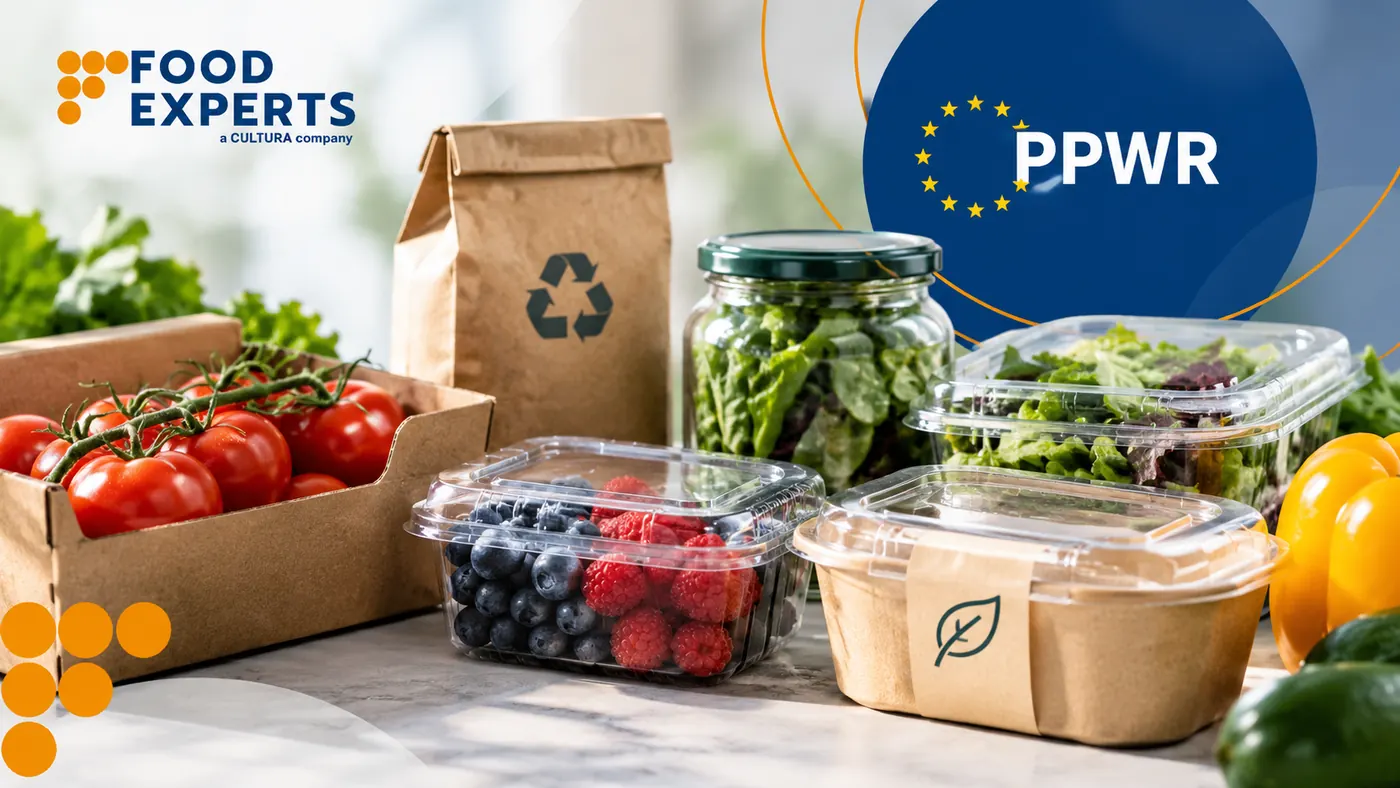
Since 12 August 2026, the new EU Packaging and Packaging Waste Regulation (PPWR) has applied across the European Union.
There has been a lot of talk about recyclability, recycled content, PFAS, reuse and packaging reduction. And rightly so. The PPWR is a major change in the way Europe designs and manages packaging. Many of its measures will also be phased in over the coming years.
But at FoodExperts we believe there is another change, less visible and possibly just as important.
Packaging is no longer just packaging
Let's take something that seems simple: a plastic tray used to sell fruit.
Until now, an organisation could hold its technical specification, migration tests, composition information, supplier certificates and various declarations separately.
With the PPWR, things start to change.
Companies need to be able to prove which packaging they are using, who makes it, what materials it contains and what evidence shows that it meets the requirements that apply to it.
In fact, the Regulation requires manufacturers to draw up technical documentation before placing the packaging on the market and to issue an EU Declaration of Conformity once compliance has been demonstrated. In addition, each piece of packaging must bear a type, batch, serial number or other element that allows it to be identified.
That is where the real change lies.
Compliance is becoming tied to the specific identity of the packaging.
Suppliers also become part of the information system
There is another aspect of the PPWR that is perhaps receiving less attention.
Article 16 states that suppliers of packaging or materials must provide the manufacturer with the information and documentation needed to demonstrate the conformity of the packaging.
This makes compliance necessarily collaborative.
A retailer, importer or manufacturer may have hundreds of suppliers and thousands of items. And each one may end up linked to different evidence:
Specification → Declaration of conformity → Composition → Tests → PFAS → Heavy metals → Recycled content → Recyclability → Certificates
The question is no longer:
"Do we have the document?"
It becomes:
"Do we have the right evidence for this specific packaging, from this specific supplier, for this specific requirement?"
For us, that difference is fundamental.
The next PPWR bottleneck may be documentation
Many organisations are currently focusing their efforts on adapting materials and designs.
But there is a second challenge that will probably become more evident as implementation progresses: how to keep all that evidence up to date, connected and accessible at scale.
A PDF saved in a folder is not traceability.
Nor is a spreadsheet showing that a supplier delivered a certificate two years ago.
Real traceability comes when we can connect:
Supplier + packaging + specification + requirement + evidence + version
and quickly understand the compliance status.
The PPWR also requires the technical documentation and the EU Declaration of Conformity to be kept for five years for single-use packaging and ten years for reusable packaging.
So we are talking about building a compliance history that will have to be maintained for years.
From managing documents to managing evidence
At FoodExperts we have spent 20 years watching a similar evolution in the food industry.
First it happened with certificates.
Then with analyses.
Later with audits, supplier documentation, and technical, environmental and ethical requirements.
The pattern is usually the same: when a new regulatory requirement appears, companies first try to manage it with emails, folders and spreadsheets.
Until the volume makes that model stop working.
We believe the PPWR may be that same turning point for packaging.
That is why we are extending the capabilities of FoodExperts Compliance so that the same logic used to manage supplier requirements and evidence can also be applied to packaging compliance: technical specifications, Declarations of Conformity, migration tests, PFAS, heavy metals, recyclability certificates and other related documentation.
Not because the PPWR needs another folder to store documents.
But because it needs a way to connect those documents to what they actually prove.
Packaging is entering the era of digital compliance
Perhaps this is one of the less obvious consequences of the PPWR.
We are moving from managing packaging mainly as a product specification to also managing it as a compliance object.
And that changes the questions organisations will need to be able to answer.
Not just:
"What is this packaging made of?"
But also:
- Can we prove it?
- Do we have the evidence?
- Is it up to date?
- Which supplier provided it?
- Which item does it relate to?
- Could we find it quickly if we were asked for it tomorrow?
At FoodExperts we believe this will be one of the big challenges of the coming years.
Because with the PPWR, complying will matter. But being able to prove it will matter just as much.