Plant protection legislation and RASFF alerts: October 2026
Summary of the main regulatory developments published between September and October 2026 on plant protection products, maximum residue levels (MRLs) and biocides in the European Union and Great Britain, together with an analysis of RASFF residue alerts for the period.
European Union: published regulations
Renewal of active substances (Regulation (EC) No 1107/2009)
- Phosphine. Commission Implementing Regulation (EU) 2026/1968, published on 8 September 2026. Entry into force: 28 September 2026.
- Pyraclostrobin. Commission Implementing Regulation (EU) 2026/1976, published on 9 September 2026. Conditions: unacceptable co-formulants under Commission Regulation (EU) 2023/574; particular attention to metabolites 500M07 and 500M54 in water and sediment when used on grapes, together with BF 500-15 and 500M58.
- Mecoprop-P. Commission Implementing Regulation (EU) 2026/2025, published on 11 September 2026. Renewed as a candidate for substitution from 1 October 2026 to 30 September 2033, moving from Part A to Part E of the Annex to Implementing Regulation (EU) No 540/2011.
Maximum residue levels (Regulation (EC) No 396/2005)
- Regulation (EU) 2026/2289: MRLs for acequinocyl, deltamethrin, dodine, maleic hydrazide, pinoxaden and prothioconazole. Entry into force and application: 5 November 2026.
- Regulation (EU) 2026/2299: MRLs for difenoconazole. Application: 5 May 2027.
You can check the MRLs in force for each substance and product combination with the PPPL CB Checker.
Biocides (Regulation (EU) No 528/2012)
- Commission Implementing Decisions (EU) 2026/2127, 2026/2131 and 2026/2151, published on 13 October 2026, postpone the expiry dates of several active substances while their renewal assessments are completed.
European Union: notified drafts
Plant protection products
- Triclopyr: non-renewal of approval. Notified on 13 October 2026 (G/TBT/N/EU/1247). This is the formal step towards its withdrawal from the market. Users of the substance should plan its phase-out and review grace periods once the Regulation is adopted.
Biocides
- Ethanol (product types 1, 2 and 4): approval as an active substance. Notified on 24 September 2026 (G/TBT/N/EU/1237).
- Peanut butter (product type 19): approval as an active substance. Notified on 30 September 2026 (G/TBT/N/EU/1239).
- Reaction products of ammonium bromide and sodium hypochlorite generated in situ (BAC) (product type 12): approval as an active substance. Notified on 30 September 2026.
- Bromoacetic acid (product type 4): non-renewal of approval and repeal of Implementing Decision (EU) 2025/360, which postponed its expiry. Notified on 5 October 2026.
- Aluminium phosphide releasing phosphine (product types 14, 18 and 20): renewal of approval and repeal of the previous postponement (Implementing Decision (EU) 2025/2279). Notified on 6 October 2026.
- Magnesium phosphide releasing phosphine (product type 18): repeal of the postponement of its expiry (Implementing Decision (EU) 2025/2284). Notified on 30 September 2026.
Phosphine therefore appears under two different frameworks: as a plant protection active substance, renewed under Regulation (EC) No 1107/2009, and through aluminium and magnesium phosphides, regulated as biocides under Regulation (EU) No 528/2012.
Organic production
- List of high-risk organic and in-conversion products from third countries. Notified on 26 August 2026. Proposed application: 1 January of the year following its entry into force.
European Union: reminders
- 28 October 2027: deadline to apply for renewal of L-(+)-lactic acid (product types 2, 3 and 4) and propan-1-ol (product types 1, 2 and 4) as biocidal active substances.
Great Britain: published regulations
Great Britain is a priority export destination for much of the fruit and vegetable sector. These are the developments of the period in its regulatory framework:
- Spiromesifen. Approval expired on 30 September 2026. No grace periods have been published.
- Halosulfuron-methyl. Approval expired on 30 September 2026. No grace periods have been published.
- Bacillus firmus I-1582. Approval expired on 30 September 2026. Grace period for sale and distribution until 31 March 2027, and for storage, disposal and use of stocks until 31 March 2028.
- MRLs for pydiflumetofen in various commodities (GB MRL 2026/018). In force from 7 October 2026.
- MRLs for flonicamid in strawberries and leafy brassicas (GB MRL 2026/019). In force from 20 October 2026.
- Isoflucypram. Following the assessment of confirmatory data, the Health and Safety Executive maintains the approval unchanged: minimum purity of 960 g/kg and relevant impurity BCS-CN45153 at no more than 1.0 g/kg.
- Citric acid (biocides, product type 2): expiry date postponed to 2031.
RASFF residue alerts: 11 September to 26 October 2026
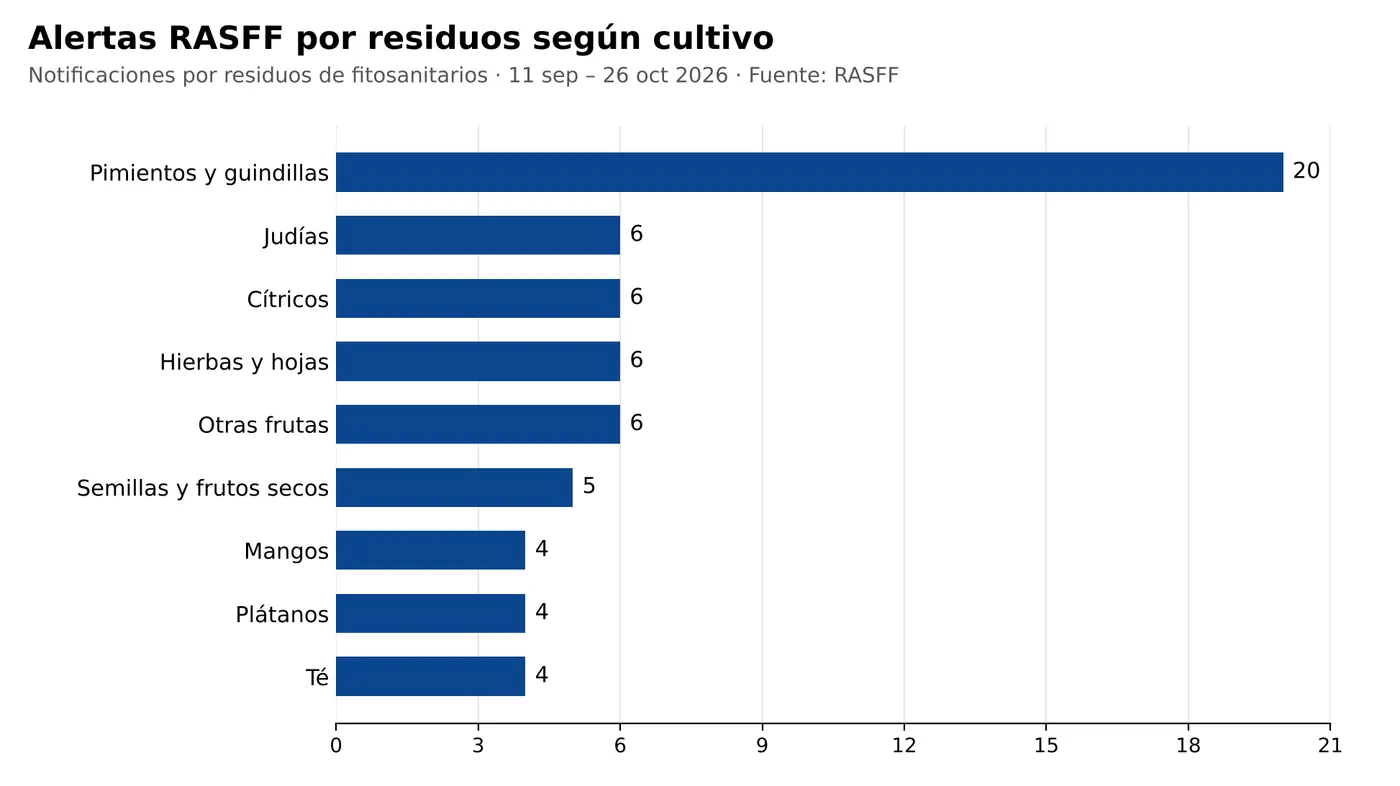
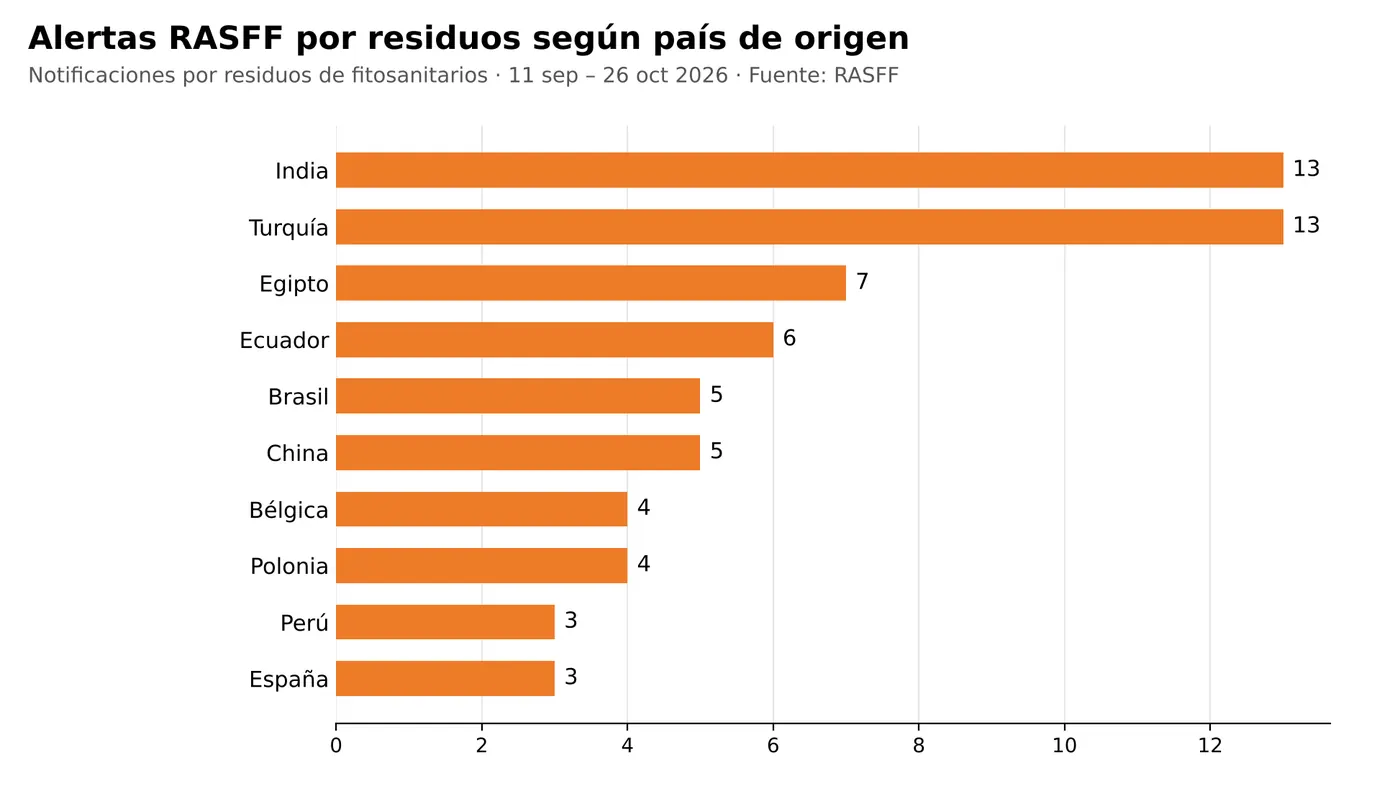
Most frequently notified crop and origin combinations:
- Peppers and chilli peppers from Turkey: 9 notifications.
- Bananas from Ecuador: 4.
- Citrus fruit from Brazil: 3.
- Mangoes from Egypt: 3.
- Citrus fruit from South Africa: 2.
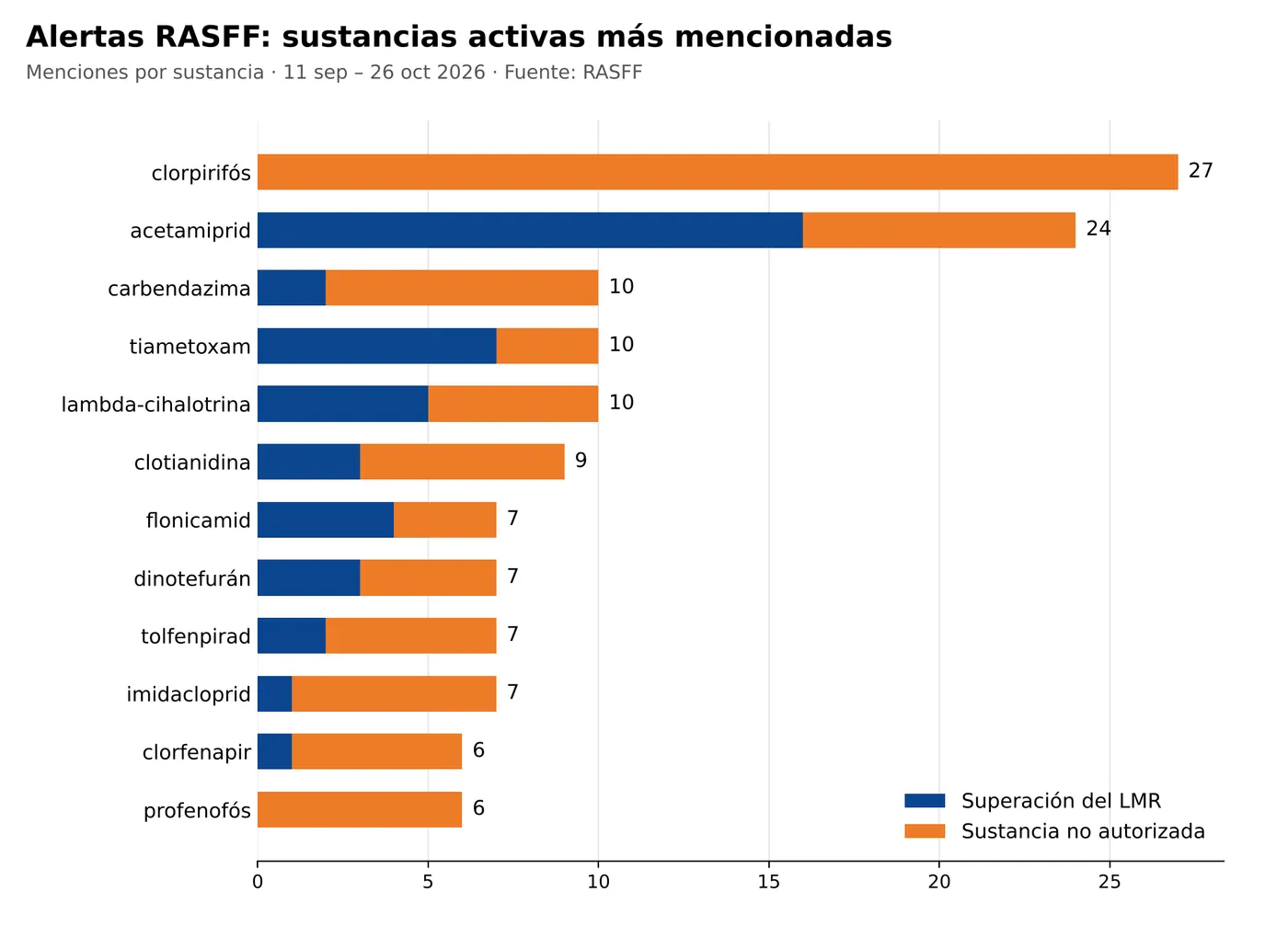
By active substance, chlorpyrifos is the most frequently mentioned (27), in all cases as a non-authorised substance. It is followed by acetamiprid (24), with 16 MRL exceedances.
Other relevant legislation: Codex Alimentarius and Listeria monocytogenes
At its 49th session (6 to 10 July 2026), the Codex Alimentarius Commission adopted the revision of guideline CXG 61-2007 on the control of Listeria monocytogenes in foods. The revision responds to updated JEMRA (Joint FAO/WHO Expert Meetings on Microbiological Risk Assessment) assessments on diced cantaloupe, frozen vegetables and cold-smoked fish.
Two changes have practical consequences: the definition of ready-to-eat food is broadened, bringing new product categories into scope, and guidance is added on environmental monitoring and on the characterisation of isolates by whole genome sequencing. It creates no direct obligation under EU or GB law, but retailers' specifications often refer to Codex guidance.
Key dates
- 5 Nov 2026: application of the new MRLs under Regulation (EU) 2026/2289.
- 31 Mar 2027: end of the sale and distribution period for products containing Bacillus firmus I-1582 in Great Britain.
- 5 May 2027: application of the new MRLs for difenoconazole (Regulation (EU) 2026/2299).
- 28 Oct 2027: deadline to apply for renewal of L-(+)-lactic acid and propan-1-ol as biocides in the EU.
- 31 Mar 2028: end of use of stocks of Bacillus firmus I-1582 in Great Britain.
FoodExperts will continue to report on any changes and on decisions on new MRLs and their application dates. If there is a substance, crop or market you would like us to follow more closely, write to us.